What is it?
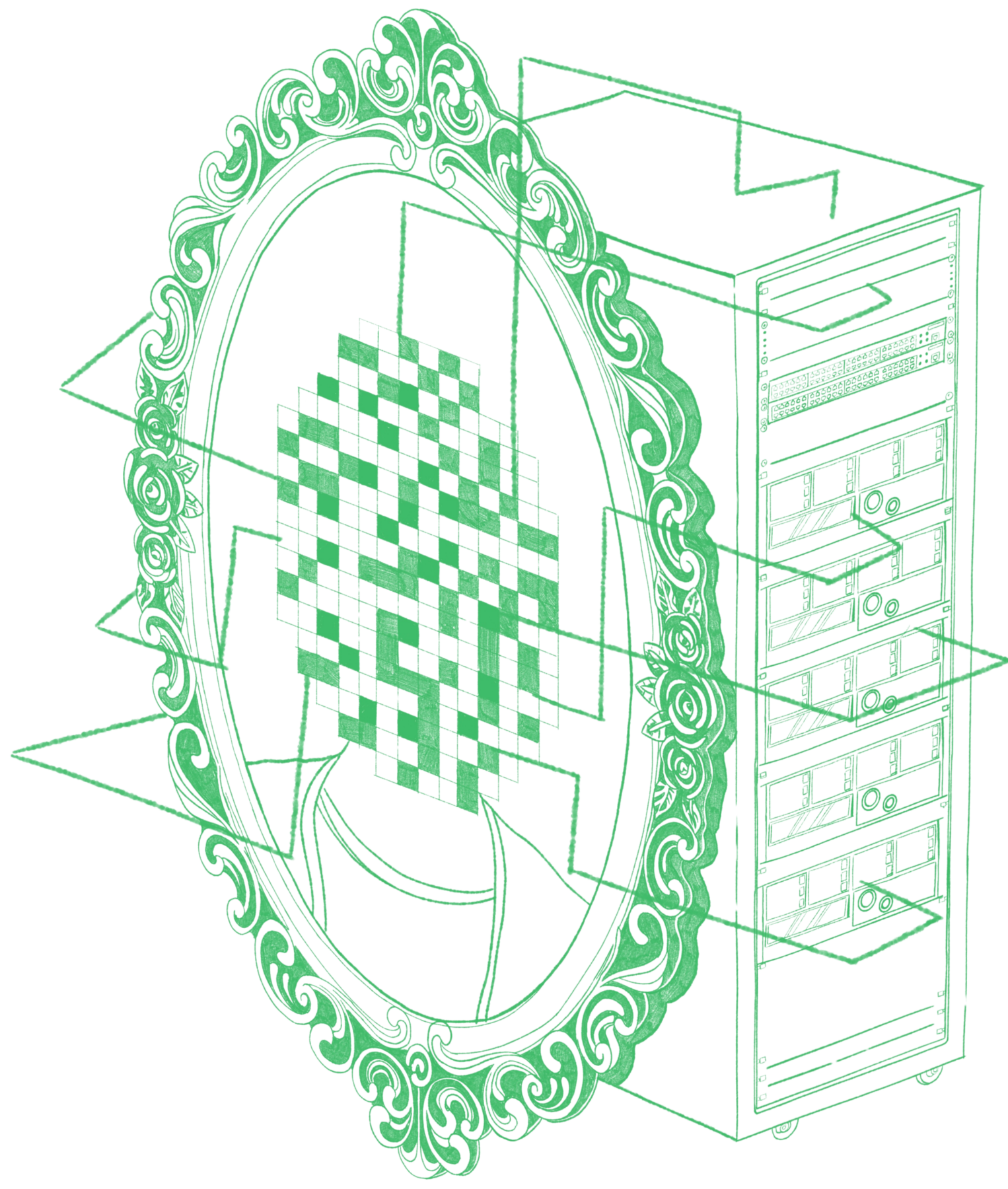
AI is often compared to the human mind. However, this is an inaccurate description of how machine intelligence works. AI technologies learn from information that already exists (such as health system data, social media posts, webpages, and digital documents) to make predictions and create outputs (such as summaries). This information ‘reflects’ back to us our past, both positives and negatives, including our biases and mistakes. The metaphor of AI as a mirror illustrates that AI does not create anything new, but instead (re)produces more of the same.
What does this metaphor suggest about AI?
By thinking of AI as a mirror, we understand it as a reflection of the human data it draws upon to generate responses, not as a sentient being. AI chatbots may, for example, reflect sentiments expressed by the user, making them feel seen and keeping them engaged. While sometimes helpful, this can be problematic, especially in the case of issues such as sycophancy. The bad parts of humanity are reflected back at us as well as the good ones.
A mirror can also distort and warp reality, as a funhouse mirror (such as those found at carnivals and fairs) does. Cognitive biases present in training data, for example concerning people from particular demographics or groups, can be amplified by AI in a similar way. Mirrors can also create the illusion of something existing on the other side, suggesting a depth which does not exist.
Where does the metaphor commonly appear?
AI is mostly referred to as a mirror in academia.
What does the metaphor highlight?
The idea of AI as a mirror serves to highlight AI’s inherent lack of agency or desire. It stresses its role as a human-made tool, while acknowledging its potential to draw people in and even change perceptions of reality.
It can also be taken as a warning, evoking the image of Narcissus – a figure from Greek mythology who famously fell in love with his own reflection in a pool of water. This is particularly relevant in the case of chatbots, which come to increasingly predict and reflect user preferences over time. This can lead to users becoming dependent on them, and even fostering relationships with them.
What does the metaphor hide?
While a mirror is a simple and relatively standardised piece of technology, an AI system is not. They are complex systems brought about through human decision-making – such as what data should be collected, what a good model looks like, and what the system should optimise for.
The metaphor also hides who makes these decisions, and therefore who AI is a reflection of. With frontier models, the training data is not a reflection of humanity, but rather mainly Western and English-speaking populations.
Whose interests does it tend to serve?
The metaphor is especially of interest to those seeking to avoid anthropomorphising AI systems. Though it is commonly used to emphasise a lack of consciousness in AI, it could also potentially reinforce unhelpful anthropomorphic ideas and attachments by encouraging users to regard AI as a personal reflection of themselves and creating deeper emotions of intimacy.