
AI as an octopus

“What if, in addition to human-like brains, we looked to octopus minds for fresh ideas on how to build and train AI?”

Bill Parker (2025) 

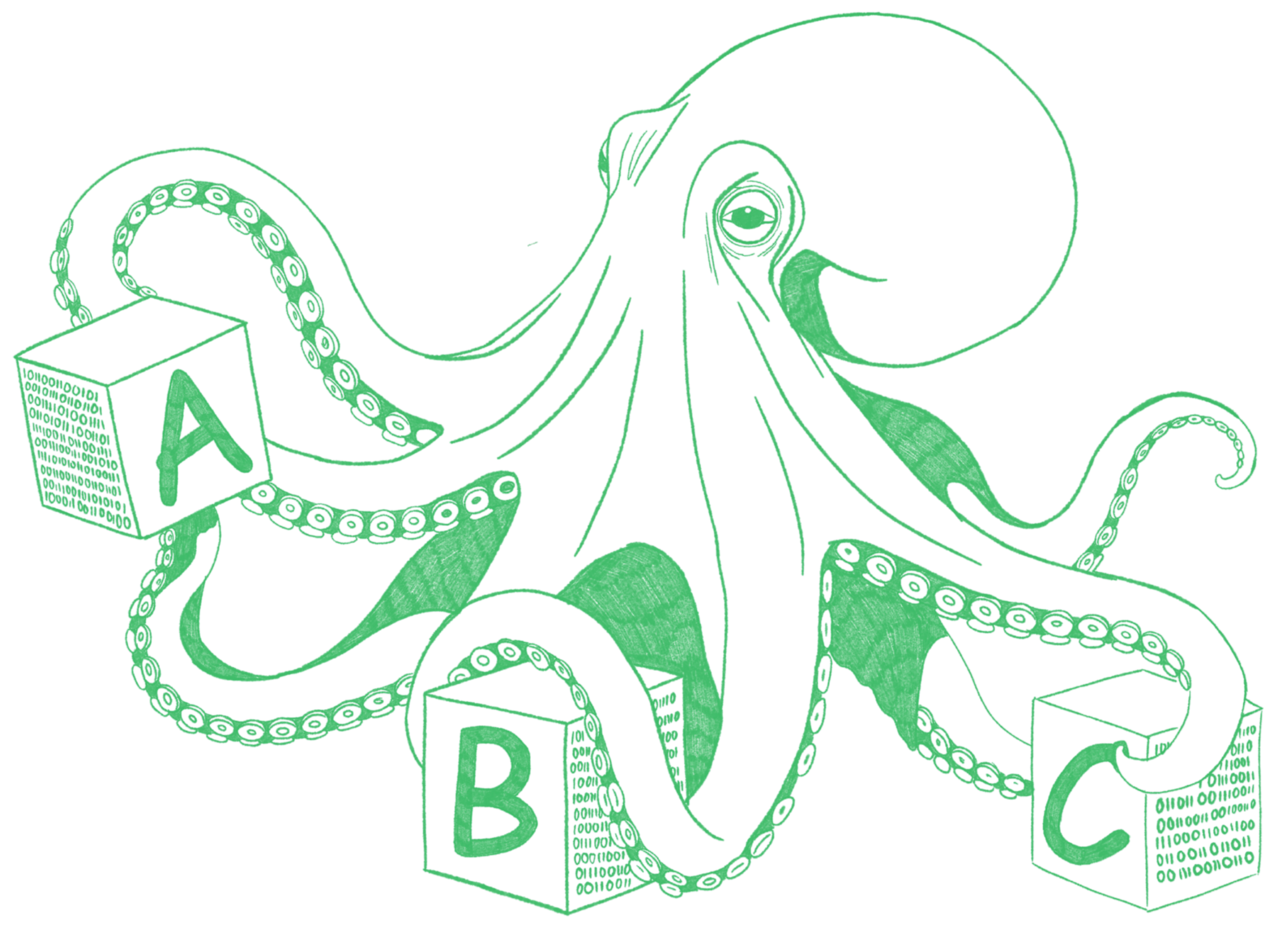
A drawing in green ink depicts an octopus holding children's blocks with letters as well as bits and bytes

What is it?

The octopus metaphor compares AI to non-human forms of intelligence in the natural world.

Where does the metaphor commonly appear?

This metaphor is mostly used in academic texts.

What does this metaphor highlight?

The ‘octopus test’ was intended to highlight how a form of intelligence is able to replicate patterns of speech without understanding them. Any ‘meaning’ in what it produces, comes from the human recipient giving meaning in how they choose to interpret it.

However, the more common use highlights the different forms human intelligence and animal intelligence may take, to achieve the same goals such as problem-solving or communication. For example, it compares our ‘centralised’ processing in the brain, to ‘decentralised’ processing in the tentacles of an octopus.

What does this metaphor hide?

Comparing AI to octopus intelligence can lead to us attributing some form of intention or consciousness in its actions. While some writers have used it to suggest directions in which AI can be developed (e.g. different components or tentacles working independently but in tandem), others have used this to push philosophical questions about what we consider ‘true’ intelligence to be.

What makes (or could make) this metaphor work?

Popular media often portrays octopuses as intelligent, able to solve problems (e.g. popular science books like Other Minds: The Octopus, the Sea, and the Deep Origins of Consciousness) and maybe even recognise and form attachments with humans (e.g. in films such as ‘My Octopus Teacher’). While they are very different from us, they are a useful example for metaphors around types of intelligence that are different from ours.

Whose interests does this metaphor tend to serve?

Using this metaphor can be useful to those working in or writing about AI, as it gives the impression that they are developing an intelligence that can be compared to biological intelligence. It allows them to suggest that the reader is the one that needs to widen their definition of intelligence, and can oversell the capabilities of the systems they are talking about.
What are this metaphor’s origins (if known)? How has its use evolved over time?

The ‘Octopus test’ was posited in 2020 to demonstrate that language models do not ‘understand’ meaning, even if they can replicate patterns. Since then, both misunderstanding of this paper, and independent use of the metaphor, uses the octopus as a form of non-human intelligence to understand AI.

What field(s) does this metaphor tend to appear in?

This term tends to be used in tech journalism and academia.

If known, in which country or region did the metaphor first appear?

United States, Germany

Has this metaphor become a widely used term or it is niche?

Used in academic or specialist contexts only

References

Other usages of the metaphor ‘AI as an octopus’

A more unusual usage of the octopus metaphor refers to the way in which they can change their shape and pattern to adapt to the environment, and compares this to the difficulty in defining AI.

“However, we suggest that much of this difficulty can be attributed to the nature of the current problem definition in the EU AI Act, which is based on mutable features of AI. To use a metaphor, it is akin to trying to define an octopus. Defining an octopus by its changeable traits – such as colour and shape – is tricky, as these qualities shift constantly. Such an approach requires chasing a permanently ‘moving target’. An octopus’s core identity, however, lies in what does not change: eight limbs, three hearts, and a body without bones.”

Tomic and  Štimac (2024), Pinning down an octopus: towards an operational definition of AI systems in the EU AI

More on metaphors and the framework used on this website: Making Sense of AI Metaphors: A Framework for Classification and Analysis

Who collaborated on this entry

Mel Ramasawmy, Elja Daae

Family to which each AI metaphor belongs.

This methodology considers the following families or categories:

  • Essence: What is AI? Metaphors where AI is a thing or entity (i.e. tool, brain)
  • Operation: How does AI work? Metaphors that represent AI’s processes or mechanisms (i.e. stochastic parrot)
  • Relation: How do we relate to AI? Metaphors that frame the relationship between people and AI (i.e. assistant).
  • Function: What does AI do, or what is it used for? Metaphors describing the use made of AI (tutor, translator)
  • Impact: What consequences can AI have? Metaphors that frame AI’s effects, (threat, transformative engine).

Level of human-like characteristics and agency attributed to AI. This scale goes from no / minimal anthropomorphism, through to full anthropomorphism, and beyond to deification.

What other risks can this metaphor carry?

Examples of where this metaphor was used

Observatory articles
featuring this metaphor